What Is Winti? Afro-Surinamese Spirituality Explained
The spirits, the ancestors, the herbal baths and the history of Suriname's African diasporic religion, and how it differs from Hoodoo and Vodou.
A note for readers: this page describes cultural and religious beliefs within the Winti tradition. These beliefs are not scientifically proven; they are part of the lived faith of the Afro-Surinamese community. The page is educational and does not replace medical or psychological care.
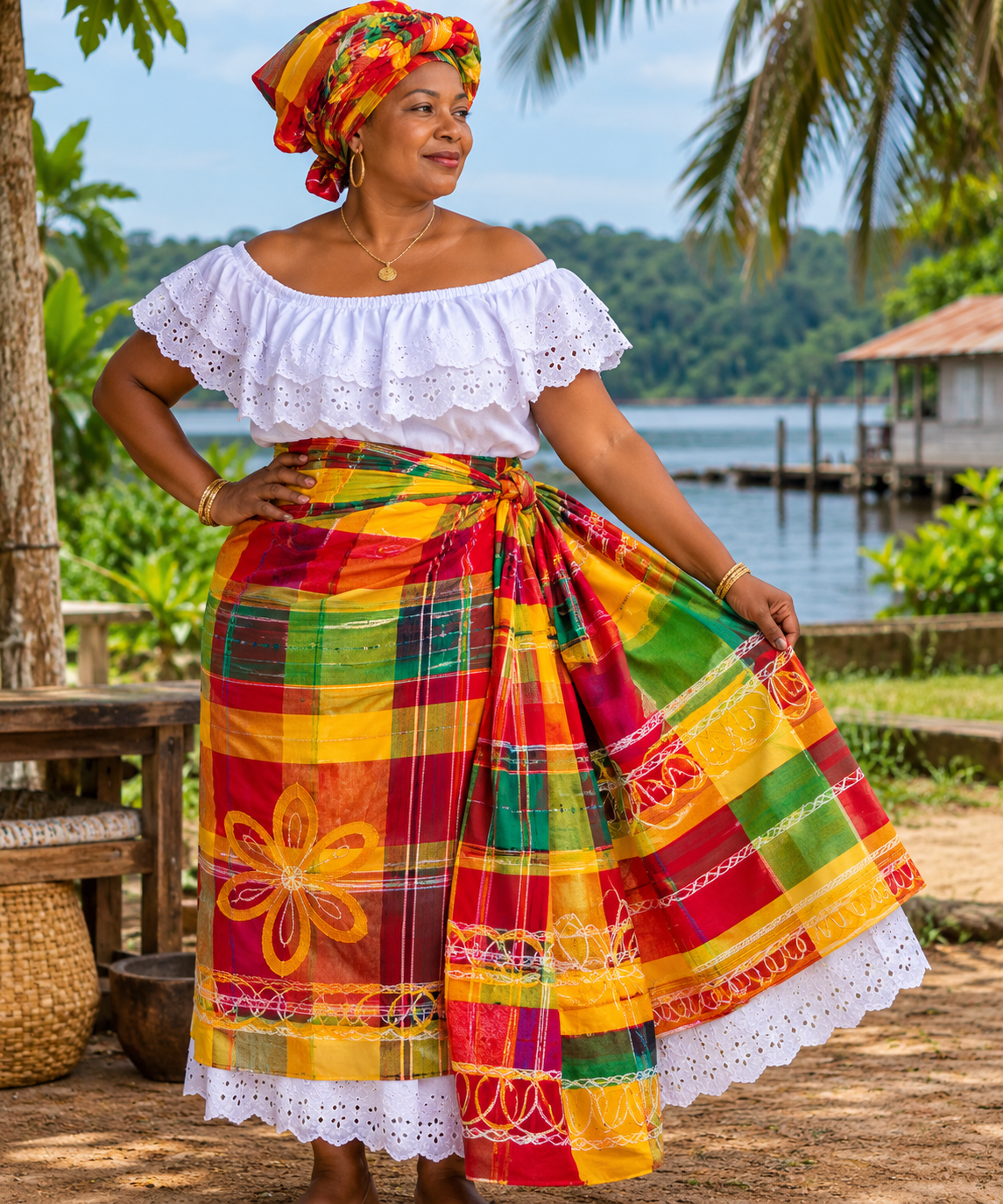
The pangi, a wrapped cotton cloth, is worn at many Winti ceremonies
Winti in short
Winti is the Afro-Surinamese religion that enslaved West and Central Africans and their descendants built in Suriname, a former Dutch colony in South America. Followers believe in a supreme creator, Anana, and in many spirits called winti that live in the earth, the water, the forest and the sky. The ancestors (kabra) stay close to the living. Practice centers on herbal baths (wasi), offerings, divination and drum ceremonies. Winti is a religion of its own, not a form of Voodoo or Hoodoo.
What does the word Winti mean?
Winti is the Sranan Tongo word for wind. Sranan Tongo is the Creole language of Suriname, and many of its words come from English, which is why winti sounds so close to wind. The name says something about the spirits themselves: like the wind, a winti cannot be seen, but you notice what it moves. In the traditions I know, a winti can come into a person during a ceremony, the way a gust of wind fills a sail.
The word is used in two ways. With a capital letter, Winti is the name of the whole religion. With a small letter, a winti is one individual spirit. So a person can say they follow Winti and that a particular winti walks with their family.
Where does Winti come from?
Winti took shape on the plantations of Suriname between the 17th and 19th centuries. The Dutch brought enslaved Africans to the colony from many regions, among them the Gold Coast (the Akan peoples of present-day Ghana), the Bight of Benin (Fon and Ewe speakers) and the Kongo-Angola region. Each group brought its own gods, ancestor practices and healing knowledge. Over generations, those different strands grew together into one religion with its own structure and its own language of ritual.

Winti grew from the religions of many West and Central African peoples
You can still hear those roots. The word kra, for the personal soul, matches the Akan word for soul. Kromanti, the name of a group of powerful spirits, goes back to Kormantse, a fort on the Gold Coast from which many captives were shipped. Researchers such as Charles Wooding have traced many other Winti terms and practices to specific African languages.
Winti survived under heavy pressure. Colonial authorities and missionaries saw it as idolatry. From 1874, article 458 of the Surinamese penal code made public Winti practices punishable, and that ban was only lifted in 1971, according to the Nationaal Archief Suriname and Duke University's Sacred Arts of the Black Atlantic project. For generations, families kept the knowledge alive in secret, passing it on by word of mouth. That history explains why Winti is still a private, family-based tradition for many people, and why practices differ so much from one family to the next.
Slavery in Suriname was abolished on July 1, 1863, although formerly enslaved people had to keep working on the plantations under state supervision until 1873. July 1 is still remembered every year as Keti Koti, "the chains are broken", in Suriname and in the Netherlands, and for many families it is also a day to honor the ancestors.
A note on terms: Winti usually refers to the religion of the Creole, Afro-Surinamese population in the coastal area and the capital, Paramaribo. The Maroon peoples of the Surinamese interior, such as the Ndyuka and the Saramaka, whose ancestors escaped slavery and built free communities in the rainforest, have their own related religious traditions with their own names and structures.
What do Winti followers believe?
At the top of the Winti worldview stands Anana Keduaman Keduampon, the supreme creator. Anana made the world, but in the traditions I know, people do not usually approach Anana directly in daily life. Below Anana stand the winti spirits, who each have their own domain, character and preferences. Below them, and very close to the living, are the ancestors.
The ancestors: kabra and yorka
The kabra are the honored ancestors of a family, the ones who are remembered and asked for protection and guidance. The word yorka is used for the spirit of a deceased person more generally. Within Winti, the dead do not simply disappear. They can appear in dreams, warn the living and expect to be remembered with offerings and respect. Many families set out water, food or a drink for their ancestors on special days. You can read more about how ancestors speak through dreams on our page about dreams within Winti (in Dutch).
The person: kra and dyodyo
Winti also has its own view of what a person is. Everyone has a kra, a personal soul, which is linked to the day of the week on which you were born. Each person also has dyodyo, spiritual parents who protect the kra. On top of that, a person can carry one or more winti, often spirits that have walked with the family for generations. When a winti feels neglected, the tradition holds that it can make itself known through dreams, recurring problems or illness that doctors cannot explain. That is why many people consult a ritual specialist when something keeps going wrong in their life.
The four realms of the winti spirits
The winti spirits are usually grouped by the realm of nature they belong to. Wooding described four main pantheons, and most families recognize a version of this order. Names and groupings do vary, though: some families place a spirit in a different group, and some spirits, like the Kromanti, are seen by many as a group of their own. The overview below follows the classification used across Spiritual Suriname.
Gron Winti: the earth
The earth spirits, led by Aisa, the mother of the earth, who is linked to fertility, stability and the land, and by Tata Loko, the snake spirit. Earth spirits are often honored first in ceremonies.
Read about Aisa (in Dutch)Watra Winti: the water
The water spirits, among them Watra Mama and the Ingi line of Indigenous origin, with Watra Ingi, Boes Ingi and Sabana Ingi. They are linked to rivers, creeks, the sea, cleansing and emotional healing.
Read about Watra Ingi (in Dutch)Apuku: the forest
The forest spirits, also called Busi (bush) spirits. Apuku is the spirit of the deep rainforest. They are known as powerful and sometimes jealous, and they are approached with care.
Read about Apuku (in Dutch)Tapu Winti: the sky
The sky spirits, linked to air, light and higher powers, headed by Tata Opete, also called Anangka Yaw. The Kromanti, warrior spirits linked to the air and seen as strong protectors, are placed close to this realm in many families.
The full guide to Winti (in Dutch)
Rivers, creeks and waterfalls are linked to the watra winti
Besides these four realms, the ancestor spirits form a group of their own. Every winti has its own colors, songs, drum rhythms, foods and drinks. In my practice, I often see that people are surprised to learn how detailed this knowledge is. It is not vague nature worship but a carefully kept body of knowledge.
How is Winti practiced?
Winti is mostly practiced within the family, with the help of ritual specialists when needed. These are the practices you will meet most often.
Wasi: the herbal bath
The wasi is the best-known Winti ritual. It is a bath of herbs, flowers and water, sometimes with other ingredients, meant to cleanse a person, protect them or bring good luck. Some wasi are taken at home; others are prepared by a specialist for a specific purpose. A sweet bath with flowers and fragrant herbs is called a switi watra. You can read more on our pages about the wasi and herbs within Winti (both in Dutch).
Safety: some traditional ingredients, such as camphor and certain oils, can irritate the skin or are harmful if swallowed, and alcohol-based products like Florida Water are flammable near candles. Ask an experienced practitioner, and do not use anything you are unsure about.
Luku: divination and consultation
A luku is a spiritual consultation in which a specialist looks into the cause of a problem: which spirit is involved, whether an ancestor is asking for attention, and what needs to be done. The specialist who does this is often called a lukuman, while a bonuman is a ritual expert who can also prepare baths, medicines and protective objects. Read more about the role of the bonuman (in Dutch).
Offerings
Spirits and ancestors are honored with offerings, such as water, rum or sweet drinks, food, eggs, fruit and flowers. What is offered depends on the spirit: each winti has its own preferences. Offerings are a way to show respect and to keep the relationship between the living and the spirit world in balance.
Winti prey: the ceremony
The winti prey (also written winti pré) is a ceremony with drumming, songs and dance, often held through the night. The drums call the spirits, and in the course of the ceremony a winti can come into a person. People say the winti "comes into the head". The person then speaks, moves and acts as the spirit. For participants, this is the moment when the spirit world is closest.
Dress: pangi and angisa
At many ceremonies, women wear a pangi, a wrapped cotton cloth, and an angisa, a folded headscarf. The colors are often chosen for the spirit being honored. The way the angisa is folded can even carry a message. Read more about the pangi and the angisa (both in Dutch).
Winti is not something you do once. It is a relationship with your ancestors and the spirits who walk with your family, and like every relationship, it asks for attention and respect.
Winti vs. Hoodoo, Vodou and Obeah
Winti is often confused with other African diasporic traditions. They share deep African roots and a history of survival under slavery, but they grew in different places and work in different ways. Our English guides on Hoodoo and rootwork explain the American traditions in more detail.
| Winti | Hoodoo | Haitian Vodou | |
|---|---|---|---|
| Where | Suriname and the Surinamese diaspora | Southern United States | Haiti and the Haitian diaspora |
| Religion? | Yes, with its own creator and spirits | No, a folk practice, often within Christianity | Yes, with its own spirits (lwa) |
| Spirits | Winti in four realms, plus ancestors | No pantheon of its own; ancestors, saints, God | The lwa, under the creator Bondye |
| Key practices | Wasi, luku, offerings, winti prey | Roots, herbs, mojo bags, prayer, candles | Ceremonies, offerings, possession, vèvè |
| Possession | Yes, in ceremonies | Not a central practice | Yes, in ceremonies |
Obeah is a fourth tradition that people sometimes mention. The word is used mainly in the English-speaking Caribbean for spiritual and healing practices. In Suriname, the related word obia means spiritual power or a spiritual medicine, and it is part of the vocabulary of Winti. For an overview of how these traditions relate, see our page on African diasporic spirituality (in Dutch).
Is Winti black magic?
No. This is the most common misunderstanding, and it goes back to colonial times, when every African religion was labeled as superstition or witchcraft. Winti is a religion about balance: between people and spirits, between the living and the dead, and within a person.
Winti itself makes a clear distinction. Harmful magic, meant to hurt someone, is called wisi, and the tradition sees wisi as wrong. Much of the work of a bonuman is actually aimed at protecting people from wisi and undoing its effects. Saying that Winti is black magic is a bit like saying that a doctor causes disease because they treat it.
Winti today: Suriname, the Netherlands and the US
Winti is alive and visible today. In Suriname, it is openly practiced and increasingly recognized as cultural heritage. Many followers combine Winti with Christianity. They go to church on Sunday and also honor their ancestors and take a wasi, without seeing a contradiction.
Because Suriname was a Dutch colony until 1975, a large Surinamese community lives in the Netherlands, mostly in Amsterdam, Rotterdam and The Hague. There, Winti ceremonies, wasi and luku are part of daily life for many families, and more young people are now openly exploring the tradition of their grandparents. Smaller Surinamese communities also live in the United States. Winti is getting attention in American academic circles too: Duke University includes it in its Sacred Arts of the Black Atlantic project, alongside other African diasporic religions.
Can anyone practice Winti?
Winti is closely tied to family lines, ancestors and the Afro-Surinamese community. In the traditions I know, you do not join Winti the way you join a club. People usually grow into it through their family, or they come to it because a winti or an ancestor makes itself known in their life.
That does not mean that outsiders are unwelcome to learn. Respectful interest is valued, and many Surinamese people are happy to share their culture. What matters is to approach Winti with respect: learn from people within the tradition, do not copy rituals from videos without understanding them, and do not sell or perform Winti practices as a commodity. The same questions of cultural appropriation that come up around Hoodoo apply here.
Sources and further reading
- Charles J. Wooding, Winti: een Afroamerikaanse godsdienst in Suriname (1972). The classic study of Winti, in Dutch.
- Charles J. Wooding, Evolving Culture: A Cross-Cultural Study of Suriname, West Africa and the Caribbean (1981). On the African roots of Winti, in English.
- Melville J. Herskovits and Frances S. Herskovits, Suriname Folk-Lore (1936). Early American fieldwork in Paramaribo.
- Nationaal Archief Suriname, on the abolition of article 458 of the Surinamese penal code in 1971.
- Duke University, The Sacred Arts of the Black Atlantic: Surinamese and Dutch Winti.
- Oral tradition and 28 years of practice within the Winti tradition by the author.
Glossary
- Anana Keduaman Keduampon
- The supreme creator in Winti.
- Angisa
- A folded Surinamese headscarf, often worn with the pangi.
- Bonuman
- A ritual specialist who can prepare baths, medicines and protection.
- Dyodyo
- The spiritual parents who protect a person's soul.
- Kabra
- The honored ancestors of a family.
- Kra
- The personal soul, linked to the day of the week you were born.
- Luku
- A spiritual consultation or divination; the specialist is a lukuman.
- Pangi
- A wrapped cotton cloth worn at ceremonies.
- Sranan Tongo
- The Creole language of Suriname, in which most Winti terms are used.
- Wasi
- A ritual herbal bath for cleansing, protection or good luck.
- Winti
- "Wind": the religion as a whole, or one individual spirit.
- Winti prey
- A ceremony with drums, songs and dance in which spirits are called.
- Wisi
- Harmful magic, which the Winti tradition rejects.
- Yorka
- The spirit of a deceased person.
Frequently asked questions
What does the word Winti mean?
Winti means wind in Sranan Tongo, the Creole language of Suriname. Like the wind, the spirits cannot be seen, but you notice what they move. The word is used both for the whole religion and for one individual spirit.
Is Winti a religion?
Yes. Winti has a supreme creator, Anana, a large world of spirits in four main groups, a view of the human soul, ancestor veneration, ritual specialists and ceremonies. It developed in Suriname from the religions of enslaved West and Central Africans.
Is Winti the same as Voodoo or Hoodoo?
No. All three have African roots, but Winti grew in Suriname, Hoodoo in the southern United States and Vodou in Haiti. Hoodoo is a folk practice without its own pantheon, often practiced within Christianity, while Winti and Vodou are religions with their own spirits and ceremonies.
Who is Anana in Winti?
Anana Keduaman Keduampon is the supreme creator in Winti, who made the world. In daily religious life, people mostly turn to the winti spirits and the ancestors rather than to Anana directly.
What is a wasi?
A wasi is a ritual herbal bath of herbs, flowers and water, meant to cleanse a person, protect them or bring good luck. It is the best-known Winti ritual. Some traditional ingredients can irritate the skin or are flammable, so ask an experienced practitioner first.
Is Winti black magic?
No. That idea comes from colonial times. Winti is a religion about balance between people, spirits and ancestors. Harmful magic is called wisi, and the tradition itself rejects it. Much of a bonuman's work is aimed at protecting people from wisi.
Can you practice Winti if you are not Surinamese?
Winti is closely tied to family lines and the Afro-Surinamese community, and people usually grow into it through their family. Respectful interest is welcome, but it is best to learn from people within the tradition and not to copy or sell rituals without understanding them.
Where is Winti practiced today?
Mainly in Suriname and in the Netherlands, where a large Surinamese community lives, especially in Amsterdam, Rotterdam and The Hague. Smaller communities and interested practitioners can also be found in the United States and elsewhere.
Learn more about African diasporic spirituality
Contact
Phone or WhatsApp (international): +31 6 37028626
Email: info@lyluah.sr
From the Netherlands only: 0909-1113777 (€1.20 per minute)
Personal guidance
Do you have questions about a dream, an ancestor or a winti in your family? Rachida offers personal spiritual guidance through her practice Lyluah, with clients in the Netherlands, Belgium, Suriname and beyond.

Rachida Kacimi
Spiritual medium, clairvoyant and author with 28 years of practice within the Winti tradition. Based in Amsterdam, working with clients in the Netherlands, Belgium and Suriname.